

The Matrix of Emotion: How Our Truth Is Shaped (and How to Break Free)
- EON

- May 6, 2025
- 3 min read
Updated: May 16, 2025

We often believe that what we feel is true — but what if our emotions are more a product of our environment than of reality itself? Discover how social conditioning shapes our beliefs, why breaking free feels so scary, and how you can step into a world of greater freedom and clarity.
How Feelings Are Formed
Our feelings don’t just arise from within; they are shaped by upbringing, culture, religion, family, school, media, and social circles. Psychologists call this social conditioning — we learn through repetition what’s “right” or “wrong,” what to value, and what to fear.
A key factor is confirmation bias — the tendency to seek and trust only information that supports what we already believe. The more confirmation we get from outside, the stronger our feelings become. Combined with self-confirmation (“See? I knew it”), this builds a mental bubble — the matrix.
For example, if you’re born in a Muslim, Christian, Hindu, or Buddhist environment, you’re likely to see that faith as the ultimate truth. Your feelings say, “This is right.” But is it?
An Example: What Are Stars?
Some religious traditions describe stars (or meteors) as weapons used to drive away devils or spirits eavesdropping on the heavens. If you know only one story, you may accept that. But once you explore other sources — scientific books, documentaries, astronomy — you’ll discover that stars are giant plasma spheres whose gravity shapes galaxies and the universe. They don’t wage spiritual battles; they form the architecture of the cosmos.

The Devil at the Gate: Why We Fear the Truth
There’s a path out of the matrix, but standing at the edge is a symbolic devil whispering:
“Don’t search for truth. Think of your family who might reject you, friends you might lose, parents who might turn away. And what if your religion is right when you die? You’ll burn in hell. Turn back while you can.”
This is called existential anxiety — the fear of the unknown, of losing our worldview, and of being cast out from our group. Humans are social creatures; rejection triggers the same brain regions as physical pain. That’s why breaking free is so hard, even when deep inside we know something feels off.
The Way Out: How to Break Free

Those who dare to look beyond discover a world full of new perspectives: books, documentaries, science, philosophy. Research shows that cognitive flexibility — the ability to hold multiple viewpoints — is key to growth and mental well-being.

But be ready: the outside world may resist. Families often (consciously or unconsciously) see children as extensions of themselves. They may say “follow your own path,” but when your path challenges their beliefs, you’ll likely face pushback. Here, family loyalty and group pressure come into play.
The Cosmic Dance of Truth
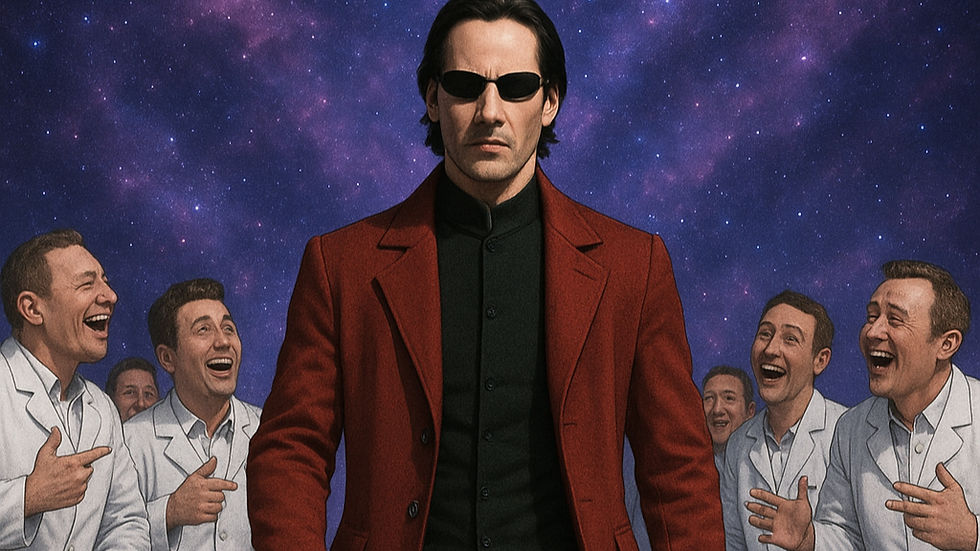
The matrix is a web of beliefs, woven from countless tiny confirmations. Those who break free dance, in a sense, among the stars — beyond fear, in a universe of possibility. Truth isn’t static or owned by one book, one tradition, or one culture. Truth is a journey — one that begins the moment we realize: feelings are real, but they’re not always true.
Call to Action:
Ready to challenge your matrix? Start by reading a book or watching a documentary outside your usual bubble. Ask questions, stay curious, and remember: the journey toward truth is the greatest adventure you’ll ever take.



Comments